
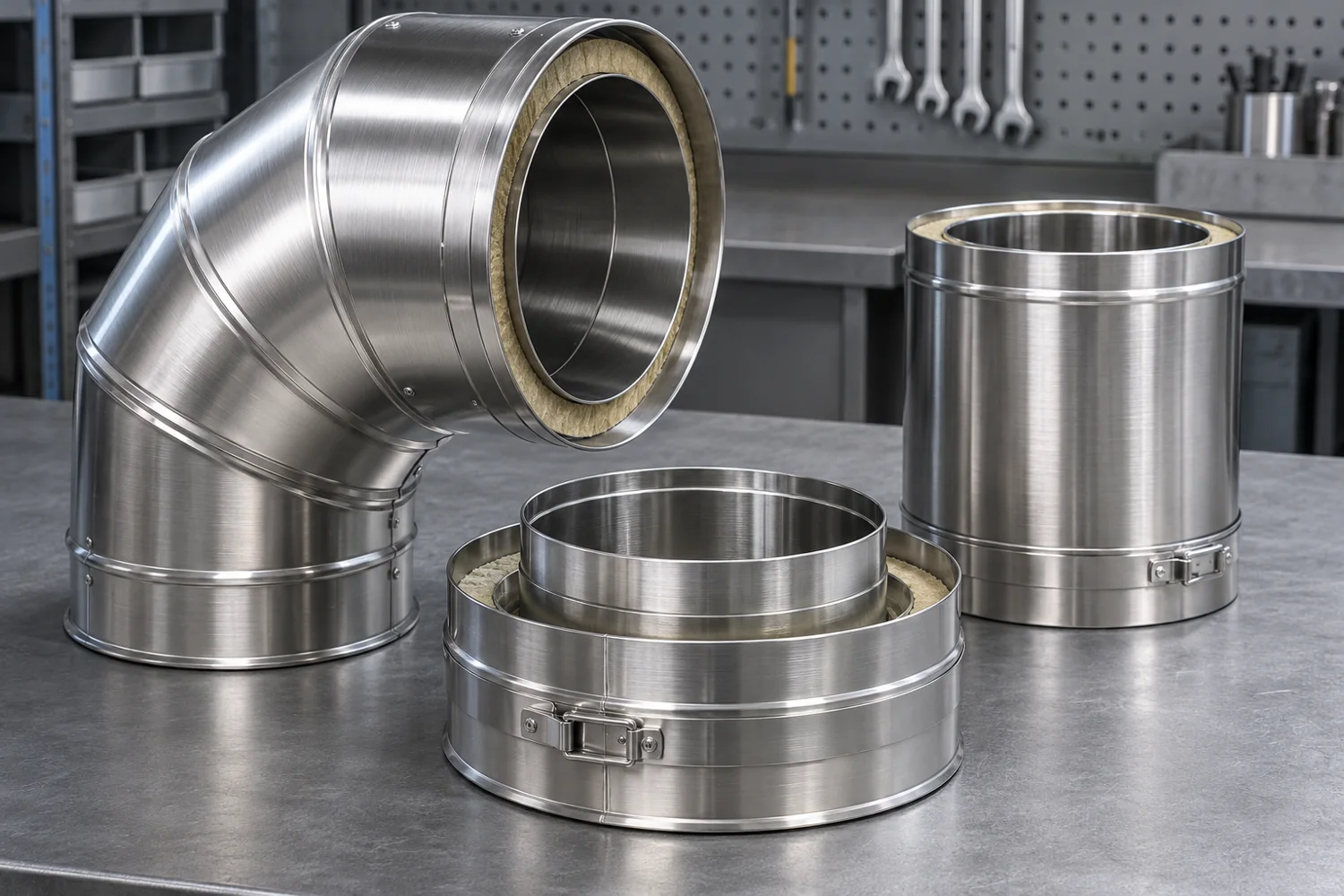
Sizing inputs and standards
- Historical estimator options
- The historical estimator lists 200–1,000 mm internal diameters, grades 201, 304 and 316, and sheet thicknesses of 0.8, 1.0, 1.2 and 1.5 mm. Confirm supplied specifications against the agreed equipment schedule and drawings.
- Liners and insulation
- Specify the grade and thickness (mm) of the inner and outer liners and the insulation type, thickness and temperature rating. Select materials for flue gas temperature, condensate and exposure. Consult GB/T 3280-2015 for cold-rolled stainless steel sheet.
- Dimensions and operating conditions
- Provide internal diameter (mm), straight run length (m), design exhaust flow (m³/h), temperature and allowable pressure or draft (Pa). Mark elbows, tees, drains, access points and supports.
- Straight-run example
- A 500 mm nominal inner diameter over an 8 m straight run gives about 12.57 m² of developed inner liner area. List the outer liner, insulation, seam allowances and fittings separately.
- Boiler flues
- For boiler rooms, check the flue layout against GB 50041-2020 and project requirements. Confirm design and acceptance conditions from the project documents.
Project questions
Can I use the area estimate as a purchase quantity?
The calculator returns the developed area of straight cylindrical sections. For purchasing, also allow for forming, joints, waste and fittings.
What other site details are needed?
Provide the exhaust medium and temperature, route, supports, wall and roof penetrations and maintenance clearances.
Before requesting a quote
- Operating conditions
- Verify whether diameters are inside or outside and whether lengths are straight or measured along the centreline.
- Installation and access
- Estimate straight sections with circumference times length and record liner and casing thickness separately.
- What to confirm
- List elbows, tees, flanges, supports, transport and installation separately.